Amol Desai
  • Home
  • About
  • Macro Economic Forecasts
  • Home
  • About
  • Macro Economic Forecasts

Media - From A Franchise To A Business

9/18/2023

8 Comments

 
The once insurmountable traditional media MOAT has been under attack for the past half-decade.
​
In his 1991 annual letter, Warren Buffett described the difference between a franchise and a business.
An economic franchise arises from a product or service that:
(1) is needed or desired
(2) is thought by its customers to have no close substitute
(3) is not subject to price regulation
The existence of all three conditions will be demonstrated by a company's ability to regularly price its product or service aggressively and thereby to earn high rates of return on capital.  Moreover, franchises can tolerate mismanagement. Inept managers may diminish a franchise's profitability, but they cannot inflict mortal damage.

Media Franchises
For several decades leading up to the mobile era, media businesses - especially TV – were economic franchises.  Great video entertainment was highly desired, and there was no close substitute.  TVs share grew while radio and newsprint declined.  Social media and user generated content did not exist.  Shows such as Friends, or Seinfeld carried the entire network.  It was Must-See-TV.
As Buffett mentioned in his letter, a desired product without a substitute in a unregulated market has pricing power.  And media possessed significant pricing power.  Media companies also tapped into the desire for Live sports to increase the volume of sports programming, introduce new sports channels, and raise prices. 
However, it had another ace in its back pocket.  It was an attractive industry structure. 

Attractive Industry Structure
In the 90’s, TCI managed by John Malone, was the dominant cable company. However, after its sale to AT&T in 1998 and the later spin-off of TCI assets, the Cable market fragmented. Multiple cable/satellite companies shared the market.  While some had dominant local positions, no one player had a dominant national position. This fragmented nature of cable played into the hands of media companies. They took full advantage of using their supplier power on their distribution partners.

Opaque and Ever Rising Prices

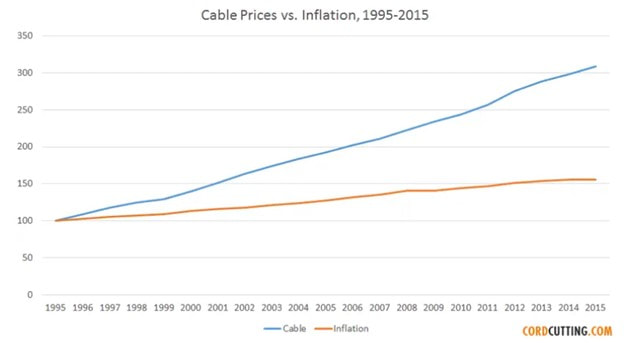
As time went on, the cable bundle kept getting larger, and the affiliate fees kept rising.  When media companies took price increases - Cable companies – took the wrath from consumers.  The cable bundle pricing was notoriously opaque.  Sports leagues negotiated larger contracts.  Sports programmers such as ESPN passed on price increases onto cable companies, who passed it on to the end consumer.  While consumers felt the rise of cable bundle prices, the attribution of the price increase was mostly unknown to the consumer (I.e. what channels in the bundle are driving the inflation.) 
Chart 1 - Cable vs Overall Inflation
Picture
Bundles Reduce Churn
Additionally, the bundled nature of the cable product and the lack of substitutes meant it was an all-or-nothing proposition.  There was no viable substitute.  Therefore, customer churn was minimal, even for the mediocre media properties.  (Cable bundle churn was ~2% per month vs 7-8% per month for streaming.)  Consumers paid for channels they did not think existed! Non-sports watching households subsidized the sports watching households.  Sports programming benefitted the most from the bundle.

Low Marginal Costs
Media businesses have low marginal cost.  The cost of producing a show is fixed, irrespective of the number of households watching it.  Therefore, as the number of households with cable TV grew, so did the profits of media companies.  This was the golden age of media and the Cable bundle was the back-bone.
However, all good times must eventually end.
The emergence of the mobile era. You Tube and user-generated content, and the rise of Netflix changed the landscape.  As the sheer volume and quality of substitute content grew, the need for traditional media shrunk.  The alternatives were either free (ad-supported) or in Netflix’s case, had low prices.  Therefore, Cable’s annual price increases became untenable to consumers.
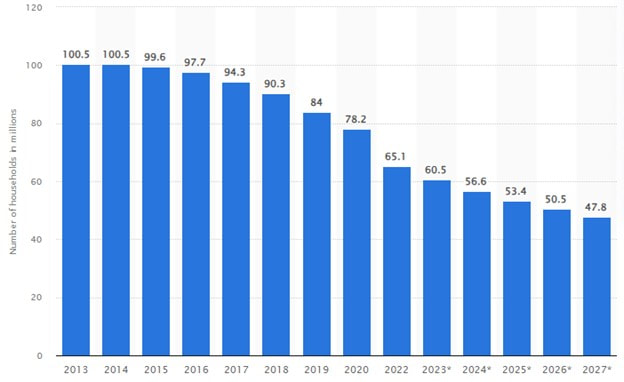
Media businesses slowly started the transition from Franchises to Businesses as chord-cutting accelerated.
​
Chart 2 - No. Of. Pay TV U.S. Households
Picture
Source – Statista
In his letter, Buffett also described a ‘business’ as "A business" earns exceptional profits only if it is
1)  the low-cost operator
2)  if the supply of its product or service is tight. Tightness in supply usually does not last long. With superior management, a company may maintain its status as a low-cost operator for a much longer time, but even then, unceasingly faces the possibility of competitive attack.
3)  And a business, unlike a franchise, can be killed by poor management.

Rise Of Netflix
As the market power of Netflix and the valuation of its stock grew, so did the desire for every Media business to build a streaming offering.  In came Disney +, Peacock, Paramount +, and HBO Max.

Streaming Is A ‘Business’

Streaming is expensive.  Binge watching shortens the shelf-life of media assets, creates high content costs, and has high customer churn.  Remember, consumers want the next hit show, aren’t locked into a bundle, and can cancel anytime to move to another service.
​
 A Vicious Cycle
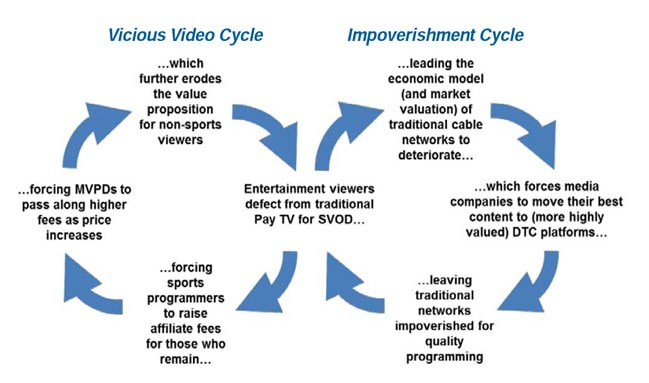
​To help reduce the burden of content creation, media businesses started taking away good content out of the cable bundle (DWTS only available on Disney +) in favor of streaming.  While this recruited new customers and retained existing customers for steaming services, taking away content reduced the already weak value proposition for the cable bundle.  Additionally, to offset the volume loss of chord-cutting house holds, media companies kept raising prices.  Higher prices combined with a lower quality offering led to more chord cutting.  Moffett-Nathanson, the thought leaders on Media and Telecom, describe this phenomenon as the vicious cycle.  While these moves maximized short-term profits, it came at a large long-term cost.
Picture
Source – Moffett Nathanson

The Disney Transition

After his return to Disney, CEO Bob Iger is accelerating Disney’s transition path from a business dependent on the cable bundle to one that is direct to consumer (DTC).   This involves adding more debt to purchase the remaining piece of Hulu (owned by Comcast), accelerating the direct-to-consumer path for ESPN, and potentially divesting the ABC network and TV station business.  Although Disney is the strongest brand in traditional media, has a highly differentiated parks business, a scaled DTC business in Disney +, a sports offering with ESPN, the earnings uncertainty through this transition is very high.

 Poor Industry Structure and Declining Pricing Power
The supplier power that was once a hallmark for Media has eroded.  Simply, Media has extracted all the profits out of the TV value chain.  Today, the Cable companies have strong broadband segments as their anchor businesses, with minimal and declining video business profitability.  With nothing to lose, they are willing to walk away from the video business.  The resolution of the recent Disney-Charter dispute where Disney had to give into Charters’ demands is a microcosm that Media has lost its leverage.

The Final Straw?

The cable ecosystem has been shrinking at a ~5% annual rate for several years.  The revenues of media companies are flat because they have taken commensurate price increases to offset declining households.  If a major sports piece such as ESPN leaves the bundle as  it transitions to DTC, it maybe the final straw for the bundle as chord cutting accelerates.  You Tube TV, as well as Hulu TV (owned by Disney) are the likely winners as Virtual multi-channel video programming distributors (vMVPD). 

From A Franchise to A Business

Where does this transition from the cable bundle to streaming leave tradition media?  I’d argue worse off.  This leaves the entire Media landscape as one with low desirability, too many substitutes, low pricing power, and poor industry structure.  While the cable bundle had incredibly low churn and strong leverage over its distributors(Cable/satellite companies), the DTC industry structure has higher costs and significantly high churn. 
​
 It was a good run for traditional media.  Good times never last forever. 
8 Comments
https://kodi.software/ link
11/18/2023 09:06:36 am

I wanted to express my gratitude for your insightful and engaging article. Your writing is clear and easy to follow, and I appreciated the way you presented your ideas in a thoughtful and organized manner. Your analysis was both thought-provoking and well-researched, and I enjoyed the real-life examples you used to illustrate your points. Your article has provided me with a fresh perspective on the subject matter and has inspired me to think more deeply about this topic.

Reply
Investment Management Course link
6/15/2025 06:07:07 am

Turning a franchise into a business needs planning and financing knowledge. An Investment Management Course can help entrepreneurs understand capital structure, reinvestment strategies, and how to scale operations wisely.

Reply
marine blinds link
12/3/2025 08:55:54 am

Roller blinds are favored for their slim profile, while pleated blinds provide excellent light filtering without obstructing views. Blackout versions are ideal for sleeping quarters, creating a restful atmosphere even during bright daylight.

Reply
출장마사지 link
4/1/2026 01:26:20 am

처음 이용해봤는데 기대 이상이었습니다. 예약도 간편하고 응대도 친절해서 신뢰가 갔어요. 특히 중간 과정에서 출장마사지 덕분에 하루 종일 쌓였던 피로가 눈 녹듯 사라졌습니다. 집에서 받는 편안함과 전문적인 기술이 결합되어 만족도가 높았고 다음에도 꼭 다시 이용하고 싶습니다.

Reply
출장마사지 link
4/19/2026 03:07:23 am

운동 후 회복이 더디던 차에 이용했는데 근육 피로가 빠르게 풀려 만족도가 높습니다. 이동 없이 받을 수 있는 출장마사지 서비스는 바쁜 직장인에게 정말 실용적인 선택이라고 생각합니다.

Reply
출장마사지 link
4/26/2026 01:42:08 am

집에서 받을 수 있어 이동 스트레스가 없고 시간 활용이 효율적이었으며, 전문적인 마사지로 출장마사지 경험이 매우 만족스러웠습니다.

Reply
상품권현금화 link
5/4/2026 01:13:03 am

전체적으로 신뢰할 수 있는 서비스이며 편리함이 돋보입니다. 중간 과정에서 상품권현금화 기능을 활용하면 자금 흐름을 효율적으로 관리할 수 있습니다.

Reply
룸알바 link
5/4/2026 03:12:05 am

수익 구조가 비교적 빠르게 체감되는 편이라 동기부여가 되고, 근무 시간 선택이 자유로워 생활 패턴에 맞추기 쉬우며 유흥알바 경험을 통해 경제적 목표 달성에 도움이 되었다고 생각됩니다.

Reply


Leave a Reply.

    Amol Desai

    I am an investor and these are my personal thoughts on investing, behavioral finance, markets, and sports viewed through the prism of a Latticework

Proudly powered by Weebly